
Case Study | 3D vision-guided various kinds of leaf springs loading sulution
#Leaf spring
Leaf spring is the elastic element of the suspension system of off-road vehicles, trucks, construction cranes and other wheeled vehicles, which plays the role of shock absorption and cushioning. When it is placed in the longitudinal direction of the car and one end is connected to the frame as a fixed hinge, it can also take on the role of transmitting all the forces and moments in all directions, determining the trajectory of wheel movement and playing the role of guidance. Leaf springs are widely used because of their reliability, simple structure, short manufacturing process, low cost and greatly simplified structure.
Today, we will share the story of how 3D vision system helps our user to realize flexible production. Our user is a manufacturing company under a large automotive group. It supplies a large number of leaf spring workpieces to the group's internal car companies and external customers, and is a high-quality supplier to many car companies. Due to the high volume of daily shipments, the customer has been expanding its processing line and deploying industrial robots and 3D vision systems to enhance the automation and flexibility of the production line. So, what can the increased automation and flexibility bring to the customers?
1.Improve the processing capacity of production line
In this case, the user needs to deploy an industrial robot at the loading station in front of the hot furnace to pick up a single spring steel workpiece (hereinafter referred to as workpiece) from the frame and feed it into the hot furnace. The user wants to achieve flexible robot production through 3D vision to improve the productivity of the station for different incoming materials.

There are many types of workpieces, conventionally divided into non-bending pieces and bending pieces, and there are a variety of subdivision differences in each classification, which users require to complete the identification and positioning, and to meet the subsequent addition of workpieces of different sizes and types.
The different types of workpieces determine the different ways of their placement in the material rack, and it is impossible to realize the multi-piece feeding of bent and rolled edge pieces through the flexible absorption of magnets, which requires precise positioning of 3D visual slice, and at the same time, in order to meet the requirements of hot furnace feeding placement, the positioning points need to be strictly pointed to the workpieces in the designated area.
In order to produce multi-piece springs, workpieces of different lengths need to be processed, requiring 3D vision with a wide area and large field of view, covering workpieces of different sizes from 0.8m to 2.2m.
Deviations in the consistency of processing of some workpieces, the surface may be covered with oil and rust, requiring 3D vision to have a high degree of adaptability.
The same layer of workpieces may also be stacked on top of each other, requiring the algorithm of the 3D vision system to implement a reasonable gripping strategy to avoid situations such as material pile collapse and gripping fail.
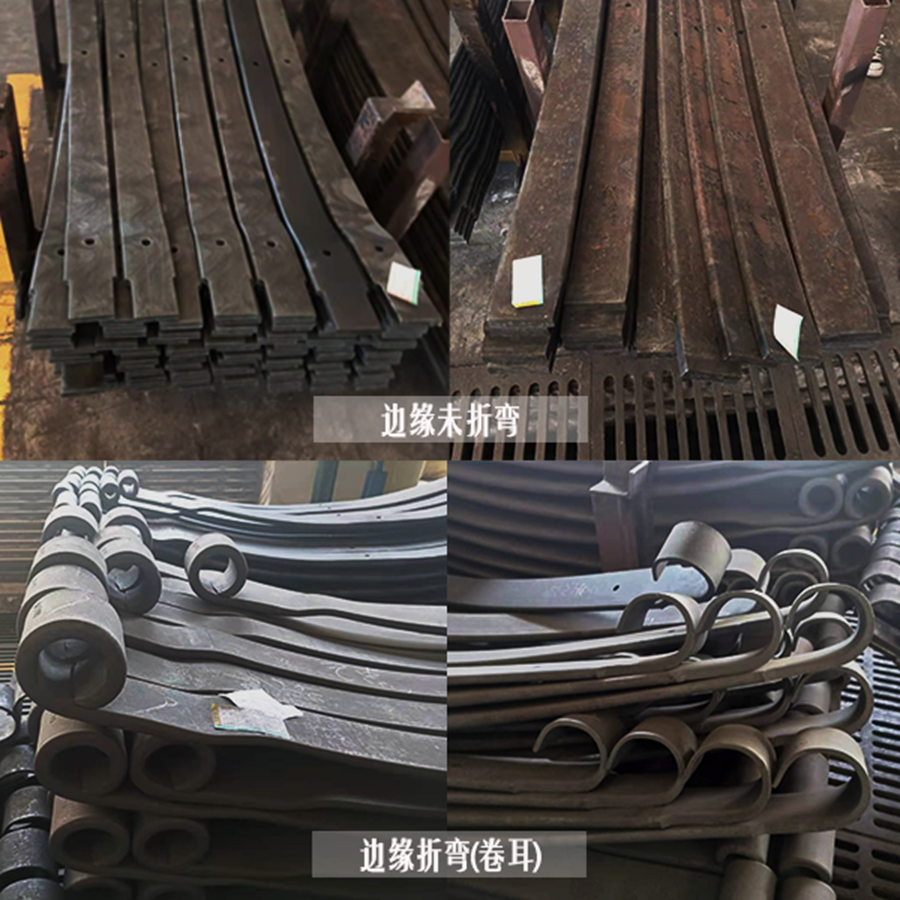
workpiece style on site
For the above needs, we choose ALSONTECH AT-S1000-01A 3D vision system for users, which adopts binocular line laser imaging solution and can efficiently identify workpieces with different specifications and features without interference from oil and rust on the surface of workpieces, with large field of view, high accuracy and good adaptability to meet users' needs of loading workpieces with different specifications. Self-developed algorithm, compatible with a variety of material template call, with the production plan and order adjustment, the user can complete the creation and import of new materials in 15 minutes, the operation is very convenient.

2. Enhance the efficiency of production line generation

The commonly used leaf spring is made of manganese steel, the weight of a single piece is 10-20 kg, which is an extremely heavy physical work for the loading workers, if the main piece of such a long workpiece, but also requires two hands, and work around the hot furnace, the temperature and operating environment are more harsh, repeatedly boring heavy physical handling, workers are prone to burnout, affecting the loading efficiency, the user needs to be replaced by mechanical automation The user needs to replace manual labor by mechanical automation means. At the same time, due to the stable orders and large shipments, the user also urgently needs to further improve production efficiency and shorten delivery time, so as to increase the number of orders and shipments and create greater revenue.
The result is clear: ALSONTECH 3D vision system AT-S1000-01A + robot = enhanced production line generation efficiency! According to the processing speed of a typical heat treatment furnace, one station can achieve ≥ 2000 pieces of workpieces loading in a regular working day (8 hours), if the user needs, the 3D vision system can also run continuously for 24 hours to guarantee the capacity and timely delivery of orders.
In order to ensure the stable operation of the vision system and not to bring the risk of production downtime for users, ALSONTECH has always demanded itself to provide industrial-grade products for users. The product shells are CNC machined, key components are selected from domestic and foreign famous brands, and the factory undergoes strict quality control management to ensure that the products can meet the requirements of most production environments and achieve continuous and stable operation, and through simple maintenance, users can achieve long-term use of 5-8 years.
3. Reduce the cost of production line deployment
The processing of leaf springs needs to go through multiple stages such as underfeeding - straightening - drilling - lug coiling - quenching - medium temperature tempering - shot blasting - assembly - pre-compression, etc. It is not limited to the aforementioned loading station before the hot furnace, 3D vision system can be deployed in multiple stations such as heat treatment underfeeding station and cutting station to guide the robot to complete the heavy handling work. The ease of deployment, efficiency and maintenance cost also affect the customer's determination to automate.
Combined with the space layout design of different stations and the loading beat requirements, we choose various installation and deployment methods such as zigzag, one-line and L-shape in the user's workshop to achieve the maximum space utilization and loading capacity.
By configuring high computing power IPC, one IPC can drive multiple 3D vision sensors (i.e. cameras) to work at the same time, reducing the hardware procurement cost of users by means of one towing two or one towing three.
By fixed installation, the 3D vision system and the robot can run in parallel on the basis of satisfying the large field of view scanning, and the workpiece scanning process does not take up the overall loading beat.
Our self-developed application software SmartVision integrates most of the algorithms of industrial scenarios, and the interface layout and operation settings are easy to use. We provide complete training for users' maintenance personnel to master the operation without too much programming knowledge, and provide technical support services around the clock to ensure stable operation of the equipment.

Site layout style
4. Excellent environmental adaptability

workstation environment
The user site part of the workstation as shown above, there are more complex interference sources, such as the left side is the production workshop door, and near the window, different light changes throughout the day, AT-S1000-01A 3D vision system using line laser program that can well adapt to the light changes, in 100000lux illumination can also be collected complete, no missing quality point cloud, and does not need to be based on repeatedly adjusting system parameter settings according to ambient light conditions, reducing the cost of shading facilities and system maintenance for users.
The workpieces need to be loaded to the hot furnace conveyor belt, although the vision sensor has a certain installation distance, but there is still a certain temperature impact, and some heat treatment under the high temperature of the station, the sensor needs to be close to the high temperature workpiece operation, the temperature of the vision system also exists a certain test. The AT-S1000-01A 3D vision sensor has a binocular structure and an optimal baseline design, which can effectively reduce the temperature drift effect on accuracy and ensure the accuracy of the vision sensor is stable in the temperature range of 0~50℃.
The deployment and stable operation of ALSONTECH's 3D vision system has effectively helped the user to implement a large number of automated loading requirements, improve production capacity and increase production efficiency. The application has been successfully replicated in multiple sets and multiple workstations within the enterprise, which has won the recognition and praise of the user.


